 recording with a software should you record in stereo on one track they pan left & right or should you record on two track's in mono they pan left & right like guitar or steel or piano if this make's any sense thank's
recording in stereo or mono
Moderator: Shoshanah Marohn
-
Gary Moore
- Posts: 200
- Joined: 7 Aug 2004 12:01 am
- Location: Mobile, Alabama, USA
recording in stereo or mono
recording with a software should you record in stereo on one track they pan left & right or should you record on two track's in mono they pan left & right like guitar or steel or piano if this make's any sense thank's-
Johan Jansen

- Posts: 3333
- Joined: 4 Aug 1998 11:00 pm
- Location: Europe
-
John Roche

- Posts: 2212
- Joined: 2 Feb 2006 1:01 am
- Location: England
Gary, if you recording vocals , always use mono, most vocals are center of the track, plus they are better for panning if you need to. fx's work better with mono as well. Backing track should be stereo , if you recording you own then all tracks are recorded in mono and panned to suit , the resulting mixdown should be to stereo. Hope this helps JR
-
Mark van Allen

- Posts: 6425
- Joined: 26 Sep 1999 12:01 am
- Location: Watkinsville, Ga. USA
Hi, Gary, sometimes stereo vocals can be a useful effect, for instance delaying one side by a few milleseconds to give a big fat vocal sound.
Backup vocals are often best in stereo, you can also get a larger "choir" backup sound by tracking stereo vocals several times with the same vocies, moved slightly in and out from the mic or eq'd slightly differently to fatten them up.
On many platforms (protools) using a "stereo" track allows panning differences, but both tracks are on the same fader, wheras using two mono tracks allows separate fader levels. Protools and other platforms usally allow you to split a stereo track into two mono tracks if you need to.
Some tracks are best in stereo, like drum overheads.
Backup vocals are often best in stereo, you can also get a larger "choir" backup sound by tracking stereo vocals several times with the same vocies, moved slightly in and out from the mic or eq'd slightly differently to fatten them up.
On many platforms (protools) using a "stereo" track allows panning differences, but both tracks are on the same fader, wheras using two mono tracks allows separate fader levels. Protools and other platforms usally allow you to split a stereo track into two mono tracks if you need to.
Some tracks are best in stereo, like drum overheads.
-
Chris Tarrow
- Posts: 477
- Joined: 27 Mar 2006 1:01 am
- Location: Maplewood, NJ
Recording the same thing on two tracks and panning them hard left and hard right will sound the same as recording in mono and panning center, although the volume may differ. Two mono tracks don't make it stereo. Stereo sources like keyboards, pianos, acoustic guitars (if you're using two mics on the guitar), drum overheads, etc. should be recorded to a stereo track. But that's recording.
What a lot of folks are talking about here like duplicating a track and putting an effect on it, tracking multiple background vocals and panning them, bussing vocals to a stereo effect, these are mixing choices.
What a lot of folks are talking about here like duplicating a track and putting an effect on it, tracking multiple background vocals and panning them, bussing vocals to a stereo effect, these are mixing choices.
-
Jim Cohen

- Posts: 21844
- Joined: 18 Nov 1999 1:01 am
- Location: Philadelphia, PA
-
Chris Tarrow
- Posts: 477
- Joined: 27 Mar 2006 1:01 am
- Location: Maplewood, NJ
two mics, usually a matched pair, over the drums that capture the whole kit and some room ambience.
http://www.prorec.com/portals/1/Wcbe9e54e6a06d.gif
Can be a close pair, spaced pair, XY, in front of the drums, various ways to set it up.
http://www.prorec.com/portals/1/Wcbe9e54e6a06d.gif
Can be a close pair, spaced pair, XY, in front of the drums, various ways to set it up.
Last edited by Chris Tarrow on 19 Mar 2008 10:40 am, edited 1 time in total.
-
Bill Terry

- Posts: 2810
- Joined: 29 Apr 1999 12:01 am
- Location: Bastrop, TX
Jim, here's a pic... exactly how and where the overheads are placed, i.e. height, etc. varies a lot. Usually room acoustics influence the 'sweet spot'.
Looks like Chris posted about the same time I did.. notice how differently the mics are placed in his linked pic and this one.. The setup in this pic is guaranteed to get a lot of 'room'. I also notice there are no other mics on the kit, so apparently the engineer is using only overheads to get the drum sound. I've had pretty good luck with just overheads myself. It depends on the kit, they music style, the room, and whether you have enough time to move the mics around and find a good spot.. There is generally a bit of trial and error involved.

Looks like Chris posted about the same time I did.. notice how differently the mics are placed in his linked pic and this one.. The setup in this pic is guaranteed to get a lot of 'room'. I also notice there are no other mics on the kit, so apparently the engineer is using only overheads to get the drum sound. I've had pretty good luck with just overheads myself. It depends on the kit, they music style, the room, and whether you have enough time to move the mics around and find a good spot.. There is generally a bit of trial and error involved.
Last edited by Bill Terry on 19 Mar 2008 10:34 am, edited 1 time in total.
Lost Pines Studio
"I'm nuts about bolts"
"I'm nuts about bolts"
-
Jim Cohen
- Posts: 21844
- Joined: 18 Nov 1999 1:01 am
- Location: Philadelphia, PA


-
Tony Prior

- Posts: 14711
- Joined: 17 Oct 2001 12:01 am
- Location: Charlotte NC
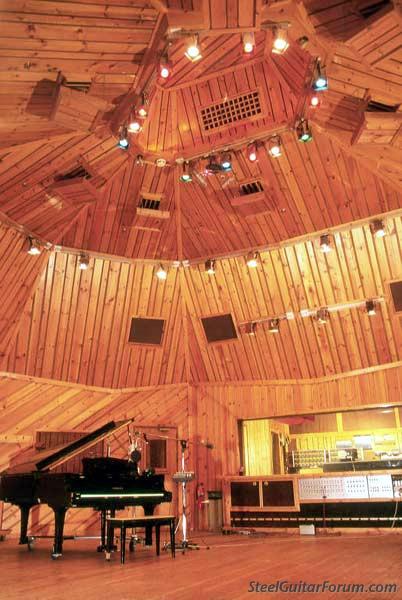
thats one NEAT room !
Recording..ahh..the timeless art that changes everyday with each new ear.
If you record in mono you are forever limited to a MONO track. If you record in true stereo your options are abundant. Neither right or wrong. Purpose is everything.
If you can get the singer to repeat a very good take on a second mono track you have even more options available.
Recording..ahh..the timeless art that changes everyday with each new ear.
If you record in mono you are forever limited to a MONO track. If you record in true stereo your options are abundant. Neither right or wrong. Purpose is everything.
If you can get the singer to repeat a very good take on a second mono track you have even more options available.
-
basilh
- Posts: 7709
- Joined: 26 May 1999 12:01 am
- Location: United Kingdom
Most reverbs and delays are mono in, but stereo out, therefore a mono track CAN have a stereo sound created from it, contrary to whats been stated above.
It's quite normal for reverbs, delays and chorus; to have differing parameters for the left and right channels to give a more natural perspective..
It's quite normal for reverbs, delays and chorus; to have differing parameters for the left and right channels to give a more natural perspective..
-
Tony Prior
- Posts: 14711
- Joined: 17 Oct 2001 12:01 am
- Location: Charlotte NC
-
John Roche
- Posts: 2212
- Joined: 2 Feb 2006 1:01 am
- Location: England
-
Tony Prior
- Posts: 14711
- Joined: 17 Oct 2001 12:01 am
- Location: Charlotte NC
-
basilh
- Posts: 7709
- Joined: 26 May 1999 12:01 am
- Location: United Kingdom
-
Alan Brookes

- Posts: 13227
- Joined: 29 Mar 2006 1:01 am
- Location: Brummy living in Southern California
I don't think there's much natural stereo about nowadays. In days of yore they would record an entire orchestra with two mikes, because they thought that the audience wanted to hear exactly what they would hear if seated in front of the orchestra in the centre of auditorium. It didn't take long for them to realise that by recording the instruments separately they could balance them later. Nowadays stereo, quad or surround sound is created in the mixing.
-
Tony Prior
- Posts: 14711
- Joined: 17 Oct 2001 12:01 am
- Location: Charlotte NC
-
Bill Terry
- Posts: 2810
- Joined: 29 Apr 1999 12:01 am
- Location: Bastrop, TX
I'm not so sure...I don't think there's much natural stereo about nowadays.
I'm working on some steel guitar overdubs for a friend who had all the initial tracking done on ProTools at a well known studio in Nashville. There were four different songs and he sent me .wav files for the tracks from each project and I imported them into my Paris system. I was a bit surprised to find that acoustic guitar, drum overheads (plus 2 separate room tracks), B-3, 2 electric guitar tracks, and piano were all recorded in 'natural stereo'.
Since I had all the stereo tracks anyway, I did a lot of experimenting with the mixes and found that all of these instruments benefited to some extent from stereo tracking IMO, but the most noticeable enhancement was on the drums (as Tony mentioned), acoustic guitar, piano and B-3 tracks. Stereo tracking on those instruments added a lot more depth and sense of space. B-3 in particular was 'twice as big'.
I don't know if tracking that much stuff in stereo is the norm in the pro studios these days or not, maybe some of the forum members who run commercial studios will chime in, but I'll bet it is. The catch is that just putting up two mics is just the beginning. You really have to know what your doing I'd expect, and doing it wrong is probably worse than not doing it at all.
Lost Pines Studio
"I'm nuts about bolts"
"I'm nuts about bolts"
-
Chris Tarrow
- Posts: 477
- Joined: 27 Mar 2006 1:01 am
- Location: Maplewood, NJ
If by "natural stereo" you mean putting up two mics and recording an ensemble live to two track, you're right, not a lot of records are made that way any more.
But the question was about recording instruments in stereo, which is very common, standard practice to record drum overheads, room mics, piano, hammond, dobro, some acoustic guitars, some electric guitars, keyboards, and many other instruments in stereo.
True that the width of the image on those instruments can be varied in the mix, things don't have to end up panned hard left and right.
But the question was about recording instruments in stereo, which is very common, standard practice to record drum overheads, room mics, piano, hammond, dobro, some acoustic guitars, some electric guitars, keyboards, and many other instruments in stereo.
True that the width of the image on those instruments can be varied in the mix, things don't have to end up panned hard left and right.
-
Earnest Bovine

- Posts: 8366
- Joined: 4 Aug 1998 11:00 pm
- Location: Los Angeles CA USA
-
basilh
- Posts: 7709
- Joined: 26 May 1999 12:01 am
- Location: United Kingdom
Probably to do with the phase content of a monaural signal compared to a binaural one, and then again there's the M&S Type to consider..after all we hear everything in the binaural mode, even the better type of deaf aids (as worn by an increasing amount of us)are now digital and "Stereophonic" albeit in a very directional manner.Earnest Bovine wrote:I think that panning a mono signal sounds different from using 2 mikes.
This article is of some significant relevance Click Here
-
Alan Brookes
- Posts: 13227
- Joined: 29 Mar 2006 1:01 am
- Location: Brummy living in Southern California
The original intention of recording in stereo was to pick up the ambience of the auditorium. Pieces were often recorded in cathedrals, etc., known for their presence. There's not much ambience in the average recording studio: in fact they pad the walls to get rid of it. Moreover, if you're going to mix stereo signals you're also mixing the ambiences.
You have much better control by adding ambience later.
You have much better control by adding ambience later.
-
Chris Tarrow
- Posts: 477
- Joined: 27 Mar 2006 1:01 am
- Location: Maplewood, NJ
Alan I think what you're saying certainly applies to a particular period of recording approaches. But natural room sounds are a big part of today's production techniques in a lot of different musical styles. Dead rooms are no longer in vogue. Take a loot at Avatar A, one of the busiest rooms in NYC:Alan Brookes wrote:The original intention of recording in stereo was to pick up the ambience of the auditorium. Pieces were often recorded in cathedrals, etc., known for their presence. There's not much ambience in the average recording studio: in fact they pad the walls to get rid of it. Moreover, if you're going to mix stereo signals you're also mixing the ambiences.
You have much better control by adding ambience later.
-
Brad Sarno

- Posts: 4958
- Joined: 18 Dec 2000 1:01 am
- Location: St. Louis, MO USA
Earnest Bovine wrote:I think that panning a mono signal sounds different from using 2 mikes.
Absolutely!
Mono (one mic) sources sound like they're inside your head. Stereo (with proper 2-mic techniques) sound wide and around and outside your head. People record in both mono and stereo all the time. Drums, acoustic guitars, pianos, room ambiences, all kinds of stuff is cool in true stereo. While many things are mono, and can be panned anywhere, it's quite cool to use two mics to create real "stereo" imaging.
Try this sometime instead of just panning to the side. Take a pair of mics in ORTF (that's about 7 inches apart and aimed about 110 degrees away from eachother) and record an instrument like a mandolin or shaker or whatever. Put the instrument in front of one of the mic's, while the other mic is sort of pointing away and to the side of that instrument. Then pull up the stereo tracks, each mic hard panned left and right, and you'll get a far more realistic side placement of that instrument than had you simply used one mic and panned it to the side. It's sort of like how our own ears hear sources from the side. We do that kind of stuff all the time. Realistic stereo imaging.
It's very important to learn good stereo mic techniques. Often times people will spread the mic's too far apart, and while that may create a wide image, it may not be very realistic sounding. XY, MS, ORTF, Blumlein, and other techniques are very well worth studying to learn the ins and outs of good stereo technique. Sometimes a mix full of mono sources with just maybe one or two instruments done in true stereo can totally make a mix come alive, pop out of the speakers, and sound 3D.
Brad
-
basilh
- Posts: 7709
- Joined: 26 May 1999 12:01 am
- Location: United Kingdom
Did I actually say that ?basilh wrote:Probably to do with the phase content of a monaural signal compared to a binaural one, and then again there's the M&S Type to consider..after all we hear everything in the binaural mode, even the better type of deaf aids (as worn by an increasing amount of us)are now digital and "Stereophonic" albeit in a very directional manner.Earnest Bovine wrote:I think that panning a mono signal sounds different from using 2 mikes.
This article is of some significant relevance Click Here