I was planning on replacing my 30+ year old speakers in my home recording setup. When I look at specs on
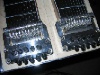
different speakers, it might state that they are nominal 6 ohms, 4 ohms, 8 ohms, or whatever. The old Pioneer speakers I have are 8 ohm I think. Don't laugh but I'm using an ordinary Teac home amp/tuner for a power amp(see picture below) .
If I connected speakers that are 4 or 6 ohm, would it cause damage to the power amp, new speakers or anything else?
No, it shouldn't damage anything. Since you're replacing speakers, however, you might consider just buying powered monitors, and taking the old Teac out of service as well.
I have to say, though, that some of the older high-end home hi-fi amps can sound better than some of the "pro" audio stuff. I have an older Adcom amp driving my passive monitors, and it sounds great. The Teac receiver is not in the "high end" catagory, and probably would not compare to the amps in decent set of powered monitors, or even a good power amp driving passive speakers.
Generally, speakers are tested at 1 kHz. Since speakers have reactive impedances, both capacitive and inductive, as well as DC resistance there must be some standard frequency to test impedance. When frequency changes, impedance changes. If capacitive and inductive reactances cancel at some frequency, the speaker becomes a pure resistive load (power factor = 1). Speaker capacitive reactance is very small and for most part is usually ignored. It is trivial to test either capacitive or inductive impedance without an impedance meter.
To test impedance, obtain a non-inductive potentiometer that has approximately twice the ohmic resistance as the suspected impedance at the desired test frequency. Wire wound potentiometers are inductive. Connect the potentiometer in series with the device to be tested. Connect the center terminal of the potentiometer to one of the potentiometer side terminals which makes the potentiometer operate as a rheostat. Connect the series circuit to a signal generator, set the output function to sine wave, and adjust the signal generator output to the desired test frequency.
Only a pure sine wave is devoid of harmonics. A test signal with any harmonics renders this test invalid.
Now, monitor voltage (AC voltmeter) across the potentiometer and voltage across the device that is tested. Vary the potentiometer until the voltage drop across the potentiometer is equal to the voltage drop across the test device. When the two voltages are equal, turn off the signal generator, disconnect one of the leads from the signal generator, and measure the DC resistance (ohms) of the potentiometer. The DC ohmic reading of the potentiometer is equal to the impedance of the test device.

 .
.